





How to cancel a credit card
Should you cancel old cards, and what's the impact on your credit rating?

If you've got credit cards you're no longer using, is it best to cancel them? Often, but not always – sometimes it's better to keep certain credit cards open. This guide takes you through the pros and cons of cancelling... and tells you which cards you should, and shouldn't, keep.
Who's this guide for? Anyone who's got unused credit cards and is wondering if they should cancel them.
Other related guides... Check your credit report | Boost your credit score | Debt help. Or, see all our credit card guides.
Should I cancel old credit cards?
There isn't a single answer to this. Sometimes it's best to cancel, and there's no downside. But other times it's not a good idea, and could even mean you find it harder to get credit in future.
Consider cancelling if:
-
You’re paying a fee and no longer use the benefits.
-
You rarely check the account. It could mean you're more susceptible to fraud, as you likely wouldn't be aware if someone stole and used your card.
-
You want to become eligible for a provider’s new-customer offers again. The time you’ll need to wait varies by provider and offer, so check the terms before cancelling. For example, American Express often requires you not to have held a personal Amex card in the previous 24 months to qualify for a welcome bonus.
-
You don't want a spending temptation: If having the card leads to unmanageable debt or overspending, closing it helps protect your finances.
Consider keeping if:
-
It’s your only credit card. You might need one for emergencies, overseas spending, car hire deposits (debit / prepaid cards often aren't accepted) or Section 75 protection.
-
It’s your oldest card or has a high limit. Closing an old card could affect the length of your credit history, while closing a card with a high limit could increase the proportion of your available credit you’re using – known as your credit utilisation.
What should I do before I cancel a credit card?
Before closing your card account, it's worth doing a little bit of admin to make sure you're not missing out on anything, or making things unnecessarily complicated for your future self.
-
Redeem any outstanding rewards or cashback. If you're cancelling a Rewards card or Airline card, you may not be able to redeem points after the card is cancelled.
-
Move subscriptions and recurring payments. If you're making regular payments for anything on the card, you'll need to make sure you pay them from somewhere else. This is usually easy to do with the provider of the service you're paying for.
-
Check whether your account is in credit. If your card provider owes you money – for example, because you’ve overpaid or received a refund – ask for it to be returned before closing the account.
-
Leave the Direct Debit in place until the balance is fully cleared. Even if the balance is at £0 on the last statement after you bought anything on the card, small amounts of interest or pending transactions could stop the account from closing properly.
How do I cancel my credit card?
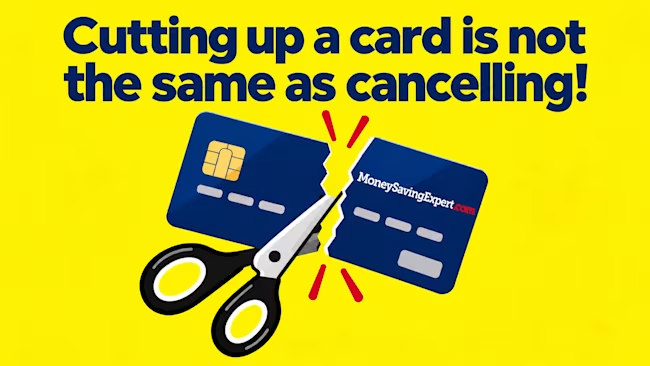
There is a big confusion here, and the only way to dispel it is to shout loud...
Cutting up a card is not the same as cancelling!
Snipping your plastic in half simply stops you using it. But the credit card will still be open, and will show as active on your credit report. To properly cancel your credit card....
Step 1: Check you don't owe anything
The best practice here is to ask your card provider for the exact settlement figure, rather than simply paying off the final statement balance (or doing a balance transfer to a different card). That way, there's less likely to be an interest surprise later on. This is particularly relevant if you pay by Direct Debit, where the statement balance is collected on the payment due date.
Step 2: Tell your card provider you want to cancel
A few will let you do this online, but you'll usually need to call or use the online chat and ask the lender to close your account. You may be able to do this online, or you may need to call or use online chat. Ask for written confirmation that the account has been closed, including the closure date and balance.
Sometimes, attempting to cancel a card can trigger your provider offer a special retention deal to make you stay. These are worth considering, especially if you still need to borrow.
Step 3: Cut up your credit card
This is the point in the process when it's usually okay to cut your card up, and your lender will usually tell you to do it (a rare few may want the card sent back). This to stop someone picking it out of your bin and using it. You may even want to put the pieces in different bins (did someone call us paranoid?).
Step 4: Check your credit reports to make sure the account is closed
It can take time for the provider to update the credit reference agencies and for the change to appear on your reports, so check again a few months after closing the account. See how to check your credit reports for free. See how to check your credit reports for free.
If the card is still listed on any of your credit reports as still open, contact the lender to ask why. If it doesn't then correct the information, see how to dispute wrong credit report info.
Get proof your credit card has been cancelled
Contact your card provider and ask it to confirm the following in writing:
-
The account has been closed at your request
-
The account balance is £0 and there's no interest, payments or fees due
-
The date the account was closed
This could be useful if a dispute arises later. If a payment, refund or interest is added afterwards, contact your provider to check what’s happened.
Once your account's closed, that's it. You can't reopen it
It's usually possible to apply for a new card with the same lender, though some – especially if they give rewards or 0% offers – will make you wait before you 'regenerate' as a new customer.
Will cancelling a credit card affect my credit score?
This will depend on your circumstances. Your score is a guide to how a credit reference agency views your finances – lenders make their own decisions using information from your credit report and your application.
Closing a long-held card may affect how lenders view your credit history. Equally, keeping lots of unused credit available isn’t necessarily best for everyone. See how to Boost your credit score for more ways to improve your chances of being accepted.
Another thing to consider is credit utilisation – this is a fancy way of saying 'how much of the credit available to you are you actually using?' and is shown as a percentage.
Closing a card reduces your overall available credit, so your utilisation can rise even if the amount you owe stays the same. A high level of utilisation may make lenders less willing to offer you credit.
For example, if you're maxed out on two cards with £2,000 limits, and you've also a card with a £6,000 limit that you're not using at all, then your credit utilisation is 40% (you've £4,000 of debt and a combined credit limit of £10,000).
If you closed the £6,000 limit card, your credit utilisation would shoot up to 100% – which would be a real red flag for lenders. They'd likely see it as a sign you're desperate for credit. So here it'd be best to keep the £6,000 card open (and, of course, aim to pay down the debt on the other two cards).
Credit card | Credit limit | Balance | Utilisation |
|---|---|---|---|
Card 1 | £2,000 | £2,000 | 100% |
Card 2 | £2,000 | £2,000 | 100% |
Card 3 | £6,000 | £0 | 0% |
Total if Card 3 kept open | £10,000 | £4,000 | 40% |
Total if Card 3 closed | £4,000 | £4,000 | 100% |
Share this guide?